


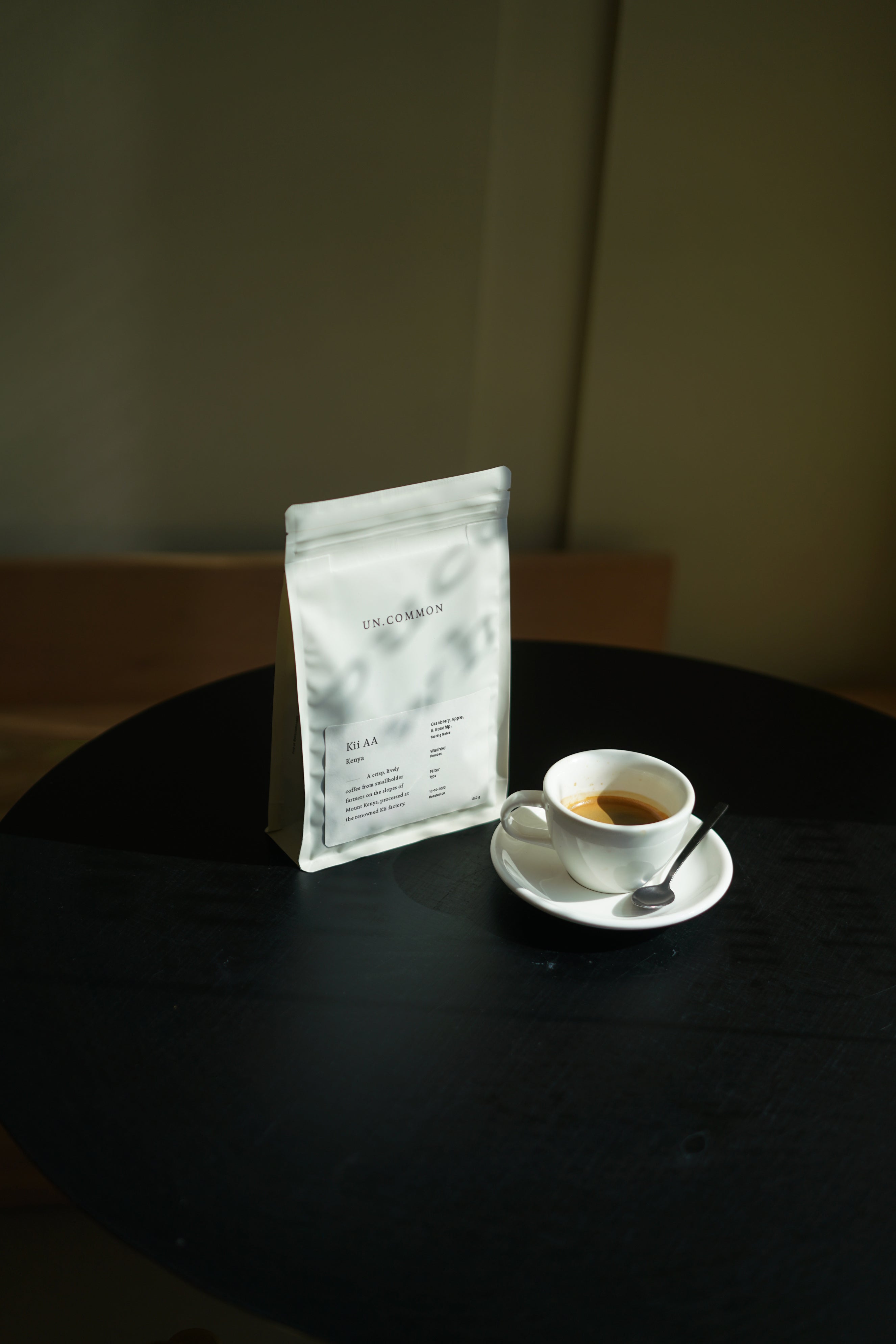
Kariaini - Kenya - Batian, Ruiru 11, SL28 - Washed
This is another lively coffee from smallholder farmers in Murang’a, processed at the Kariaini factory. The factory sits at high altitudes of 1,750 to 1,850 meters above sea level that create the ideal microclimate for cultivating sweet, dense cherry. This combined with Kenyas 'double-washed; method produces exceptionally sweet, clean washed coffees. Expect notes of mango, caramel, and blood orange.
Info
Factory
Kariaini Factory is owned and operated by Thangaini Farmers Cooperative Society (FCS) and is well known for producing high quality coffee.
Region
Kariaini village, in Murang'a, was named after what used to be a marshy area by the same name.
Curiousities
Today, more than 600,000 smallholders farming fewer than 5 acres compose 99% of the coffee farming population of Kenya. Their farms cover more than 75% of total coffee growing land and produce nearly 70% of the country’s coffee. These farmers are organized into hundreds of Farmer Cooperative Societies (FCS), all of which operate at least one factory. The remainder of annual production is grown and processed by small, medium and large land estates. Most of the larger estates have their own washing stations.
Elevation
Kariaini Factory is located in Kigumo in Murang’a where high altitudes of 1,750 to 1,850 meters above sea level create the ideal microclimate for cultivating sweet, dense cherry.
Variety
This lot is made up of Batian, SL28 and Ruiru 11. The SL varieties were bred by Scott Agricultural Laboratories in the 1930's for their resistance to drought and was widely planted throughout Kenya. Ruiru 11 and Batian are newer varieties bred for their disease resistance and high yields.
Process
The Kariaini factory uses Kenya's 'double washed' method which involves pulping, fermenting in mucilage, washing, a secondary 'soaking', and finally drying on raised African beds.
Kariaini
"The Kariaini factory works with around 500 outgrowers who deliver cherry to the washing station"
The Kariaini factory is very professionally run; their cherry selection, fermentation, sorting and separation is of a very high standard, resulting in excellent coffee. The cherries are first de-pulped mechanically, as soon as they arrive at the factory. The cherries should arrive for de-pulping as soon as possible after picking. After de-pulping, the coffee with its mucilage is fermented in large tanks for between 12 and 24 hours, breaking it down so it can be ‘washed’ off the seeds, using long washing channels. The cherries are then taken to another set of fermentation tanks, and fermented again under water, normally for a shorter time, between 10 and 12 hours. This ‘double washed’ is popular in Kenya, and is useful not only for homogenising the bean mass, but also as a secondary opportunity to sort for lower density floating seeds.


Thangaini FCS
"The Thangaini Farmers Cooperative Society represents 900 small scale farmers, who all culitvate coffee on small plots under 0.5 hectares on average.".
Thangaini Farmers’ Co-operative society operates eight wet mill factories in Muranga county, they are located between the capital Nairobi and the infamous coffee-producing town Nyeri. They run-up to the foothills of Mount Kinangop and the Aberdare range of mountains in the west.
Contact

